
Social Selling Training Online
To prosper in today’s digitally influenced market, social selling training online to understand how to use the social channels to sell should be part of everyone’s digital sales strategy.
Across the entire global sales community, social selling is being blended into the sales process, tapping into the vast amount of insights that the social networks provide to both buyer and seller. Probably the first time since John H. Patterson created his sales training methodology for NCR, salespeople have to adjust their skill sets as the now traditional forms of selling, such as cold calling, have an ever-decreasing success rate. Preparing and learning the skills so that salespeople can harness the power of social selling to engage buyers is now critical, not a nice to have.
The buyer’s journey has changed along with the profile of a typical business buyer; their wants, needs, values and how they conduct business has altered completely from 10, even 5 years ago. So a social selling training online course can show you how to use it as a genuine communication channel to share insights, research, value and content long before engaging in any sales conversations. Social selling is not a simplistic approach (how long does it take to master other sales tactics—months, even years?) for sales people to spam sales messages on X, Facebook, and on LinkedIn groups. Nor is it a means to use marketing-generated vanilla-flavored sales messages to bombard a connection. Bye, the way, if you are already doing this—STOP. The moment any potential customer gets these messages (and there is more than you think), any brand goodwill or any credibility gets flushed away. The tactic of connecting and building a network of connections just to send sales messages is NOT social selling.
If you were to take one takeaway from this article, it would be to truly build value over time with your social network by sharing relevant, quality content that people find useful and helpful. So, in time when a sales person reaches out with a personalized social touch point to a prospect to engage in a sales discussion, the chances of progressing a relationship will be greatly enhanced, and the research is now out there to prove it.
Salespeople need to learn the social selling habit loop, a daily routine to connect with your social network community with news, articles, research, videos, and snippets of information. They also need to learn, Givers Gain, starting with ways to connect your network together (as this provides value) and offering to help others connect. A good example of this is that a sales person sees a message posted on LinkedIn that says, “Where could I find some inspiration for a key note speech I have to deliver?” Instead of posting a reply such as, “I would be interested in this myself,” or “Have you tried PowerPoint?” (True reply!). Now, the salesperson finds someone in their social network that is a presentation expert and offers to put the person in touch with them. Nothing in it for the sales person, other than to build their credibility as someone who is a conduit, a connector who brings value by taking the time to listen and connect their social network. To quote “Covey”, these are a lodgement that pays off in the longer term.
Selling is simply the act of communicating and making commitments. Now, more than ever, to be successful in sales, we need to understand that (a) selling is all about building relationships and (b) providing value. With a well-planned-out social selling program, a business will gradually drive more sales than cold calling or cold emailing will ever achieve.
Always remember that all selling is inherently social, so social selling is really nothing new but rather a new communication channel. So, look at social selling as an additive process, a sales tactic to help you sell more effectively that will evolve over time.
At the Digital Sales Institute, we try to encourage sales people to separate ‘social selling’ into two main areas:
(1) Direct Social Selling and (2) Indirect Social Selling.
The direct side of social selling is utilizing the various social media networks like Facebook, Twitter, LinkedIn, Substack, and Instagram to look for conversations where one would share content/articles. A pathway to connect with people a business wants to target or nurture a relationship with. Taking the example of a CIO who tweets about their focus on reducing IT costs in the coming year. The sales person in return now shares some articles or research on reducing IT. As the interaction builds (assuming the salesperson’s product or service can help with reducing IT costs), they can at an appropriate time reach out with their first social touch point—by sending a highly personalized connection request. After a series of planned touch points, the sales person can now reach out to explain the value they might be able to bring to the buyer’s goals. Please note: this is a shortened version of the process, but the point is to look for information about what prospects or companies are doing or saying so a person or business can be highly relevant to them when they reach out via the social channels.
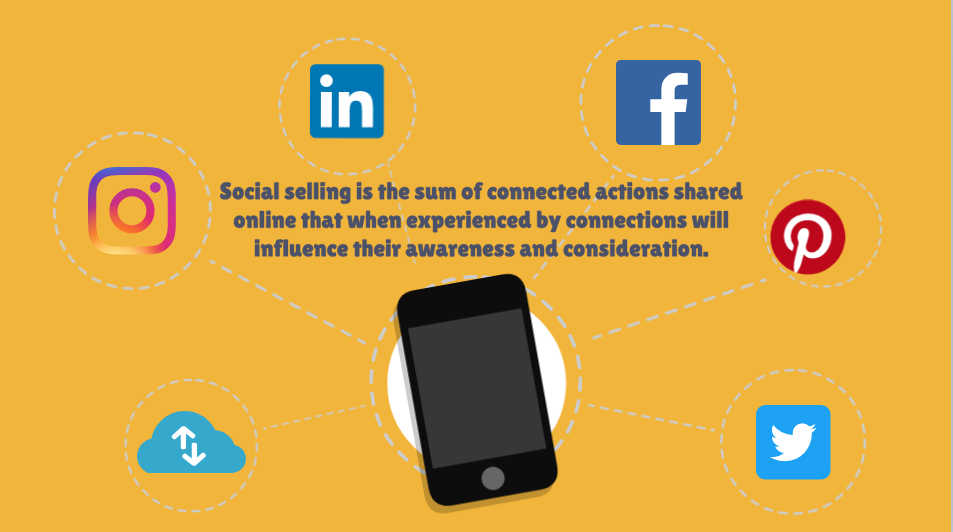
The indirect side of social selling has to do with a salesperson building their own personal brand so over time their social audience (connections and weak ties) eventually values their insights and comes to view them as a valuable industry expert, not just another weak salesperson. However, it’s important to note that this does take time and does not provide some instant results that some sales leaders think should happen these days. The reality is social selling is all about adding value to a target market, sharing not selling, helping not hindering, and being useful not useless.
We write these articles on sales to try to add some value by not just talking about the theory of selling or business but actually giving you some useful tips on sales, marketing, and business (hopefully). On our social channels, we share suggestions on what to do and how to do it. We also regularly post or retweet articles from other sources, not just about sales but about business topics that we think are important to salespeople and business leaders.
We practice what we preach; on a daily basis we review discussions in our groups on LinkedIn or Facebook, and we strive to provide honest answers to questions people ask without promoting our business or telling them how wonderful we are.
To finish up, please take the time to think through the goals, expectations, and vision for any social selling program you plan to put in place. Apart from social selling training online, spend time looking for articles, news, and research you can use to connect with people without interrupting them while at the same time positioning yourself as a thought leader by sharing quality information that is relevant. This will help you or any sales person in the digitally influenced buying/selling process, regardless of what you sell.